

Key points:
Early childhood classrooms are seeing a clear shift. Young children are starting school feeling increasingly worried and overwhelmed compared to years past. Between screen time, busy family schedules, and the pace of the modern world, young learners often arrive with big feelings before the day even starts. These feelings can manifest in a myriad of ways. A student might internalize feelings and withdraw or refuse to participate. They might also externalize behaviors indicated by difficulties in following routines, chaotic transitions, or struggles to play appropriately with peers.
While teachers can’t control what happens outside the school doors, they can prioritize creating a relationship of trust and a feeling of safety with and for their young learners. By creating a classroom space with intention, we can build a calm, predictable environment that works as a physical guard against outside anxiety and one where students and teachers feel at ease and ready to focus.
Balancing the sensory experience
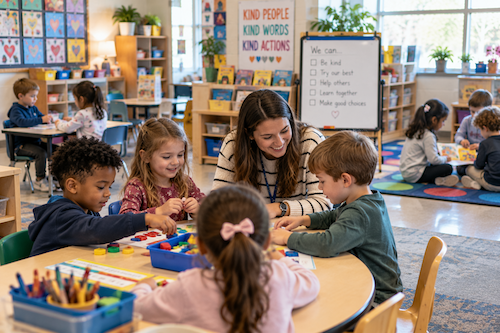
For years, early childhood classrooms were filled with bright primary colors, busy wall displays, and rows of colorful plastic bins. It was meant to be fun, but for a child who is already having big feelings, the visual noise can decrease their ability to self-regulate.
Simplifying the classroom’s visual backdrop creates an immediate grounding effect. Shifting toward natural or neutral tones, using clear storage bins or natural baskets, and limiting wall displays to necessary pictorial supports and student work helps reduce visual clutter. Lighting certainly has its place and impact as well. Research shows that natural and softer lighting lower cortisol levels and help balance mood. Replacing or softening harsh overhead fluorescents with lamps or light filters creates a more soothing ambiance.
Room layout matters just as much. Big, open spaces in the middle of a room can be an invitation for young children to run. Arranging low shelves, rugs, and furniture to clearly define areas of the classroom guides natural movement through the room and keeps transitions smooth.
Designing for a variety of regulation needs
Every child handles stress and energy differently. A good classroom layout includes simple options to support those varying needs without derailing the rest of the group.
- Flexible seating and movement: Young learners need physical engagement. Offering wiggle cushions, wobble stools, or defined carpet spaces lets children satisfy subtle movement needs during instruction without disrupting the classroom.
- Dedicated calming corners: A cozy quiet area, equipped with soft seating and tactile materials gives dysregulated students a safe space to reset. It’s not a timeout corner intended for punishment; it’s a tool for self-regulation and calming.
- Visual schedules: Most early learners are not yet able to read, so picture schedules and clear visual supports show children what to expect, building comfort and routine.
Designing for children, not adults
When setting up an early childhood space, it’s important to look at the room through the eyes of young learners rather than adult visitors. A new trend slowly creeping onto the scene are hyper-themed spaces with massive wall murals, elaborate play structures, or museum-like displays. While these setups create a “wow factor” for parents, they don’t always give students what they actually need.
Overly complex, heavily decorated rooms add visual noise and create blind spots for teachers. When a classroom feels more like a theme park, it can easily lead to overstimulation and chaotic behavior. In early childhood design, less is almost always more. Simple, open-ended arrangements let children’s imaginations take the lead without overloading their senses. Keeping the focus on child development ensures the room supports the children using it every day.
Supporting teacher well-being through layout
Classroom design also directly impacts a teacher’s daily stress. When a space is set up to reduce physical friction and support student independence, the whole day runs smoother. Studies on teacher workplace conditions show that job burnout is closely tied to environmental strain and managing constant behavioral disruptions.
A well-organized classroom acts as a partner. When pathways are clear and sensory overload is dialed back, student dysregulation drops, meaning teachers spend less energy redirecting behavior and more time connecting with their students. Accessible, low shelving and labeled bins empower children to retrieve and clean up materials independently, taking operational pressure off the teacher. Outside the classroom, clean, comfortable staff spaces give educators a place to catch their breath and reset during breaks.
Explaining the environment
Physical tools and designated areas work best when paired with clear expectations. Dedicating time early in the year to teach students how to navigate each area, like picking a flexible seat or visiting the calming corner, builds independence and cuts down on routine management.
Once expectations are set, keeping the layout consistent gives children the stability they crave. While minor tweaks based on observation are natural, avoiding frequent major reconfigurations preserves the predictability that helps children feel safe.
A practical path forward
Creating a supportive early childhood space doesn’t require over-the-top installations or complicated setups. The most effective classrooms prioritize practical, child-centered choices: warm lighting, clear layouts, flexible seating options, and reliable routines. By focusing on these core design principles, schools can build a steady sanctuary where both students and teachers can breathe a little easier.
