

Key points:
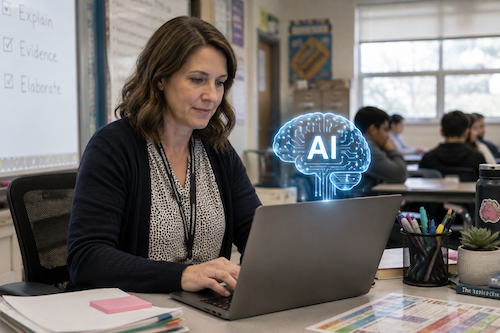
A year ago, many educators were still asking whether artificial intelligence belonged in the classroom. Some were cautiously experimenting with AI-generated lesson plans, while others were focused on preventing students from using it altogether.
Today, the conversation has evolved.
Across the country, school districts are developing AI guidance, investing in educator-specific platforms, and providing professional learning around responsible implementation. Teachers are moving beyond asking, “Can AI write a lesson plan?” and beginning to ask a much more meaningful question: “How can AI help me become a more effective teacher?”
That’s an important distinction.
The best educators aren’t using AI to replace their expertise. They’re using it to amplify it.
But the real promise of AI isn’t that it helps teachers produce more. It’s that it helps educators protect more time for the human work of teaching. When technology reduces the hours spent formatting materials, rewriting directions, or completing repetitive administrative tasks, teachers gain more opportunities to greet students at the door, confer with them about their learning, notice when something feels off, and build the trust that makes meaningful learning possible.
AI should never create greater distance between teachers and students. Used thoughtfully, it should do the opposite. It should give educators more capacity to create belonging—because before students respond to instruction, feedback, or expectations, they need to know they are seen, supported, and valued.
As you prepare for the 2026–27 school year, here are five ways AI can strengthen your teaching while keeping relationships—and learning—at the center.
1. Build an AI workflow, not just an AI toolbox
One of the biggest shifts over the past year is that AI is no longer a single tool or website.
Today’s educators are using different AI platforms for different purposes:
- Brainstorming lesson ideas
- Creating differentiated instructional materials
- Developing formative assessments
- Translating family communication
- Designing visuals and presentations
- Analyzing student work
- Summarizing research
- Organizing instructional resources
Rather than asking, “What’s the best AI tool?” begin asking, “What’s the best AI tool for this task?”
Just as we don’t rely on one program for grading, email, presentations, and data analysis, we shouldn’t expect one AI platform to meet every instructional need.
The goal isn’t mastering every new tool that appears. It’s building a workflow that helps you teach more intentionally and efficiently.
2. Differentiate faster—without lowering expectations
Differentiation has always been one of the most rewarding—and time-intensive—parts of teaching.
AI can now help teachers quickly create:
- Multiple reading levels of the same text
- Vocabulary supports
- Sentence stems
- Graphic organizers
- Extension activities
- Accommodations for diverse learners
- Multilingual resources
The objective isn’t to make learning easier.
It’s to make learning more accessible.
When teachers spend less time recreating the same lesson five different ways, they gain more time to meet with students individually, facilitate meaningful discussions, and provide targeted support.
Technology shouldn’t replace high expectations. It should remove unnecessary barriers so every student has an opportunity to meet them.
3. Let AI support student thinking—not replace it
Perhaps the most important evolution in AI has been the shift from simply generating answers to supporting the learning process itself.
Instead of asking students to use AI to complete assignments, encourage them to use it to deepen their thinking.
Students can ask AI to:
- Explain a difficult concept in another way
- Identify gaps in their reasoning
- Practice academic conversations
- Revise their writing
- Generate practice questions before an assessment
- Reflect on their own learning
The most powerful AI doesn’t think for students.
It helps students think more deeply.
That subtle shift changes AI from a shortcut into a learning partner.
4. Make AI literacy part of every classroom
Today’s students don’t simply need rules about AI.
They need instruction.
Just as we teach digital citizenship and media literacy, AI literacy has become an essential skill.
Students should learn how to:
- Write thoughtful prompts
- Recognize inaccurate or fabricated information
- Identify bias in AI-generated responses
- Verify information using reliable sources
- Acknowledge when AI has been used appropriately
- Decide when AI is helpful—and when independent thinking is the better choice
Teaching students how to think critically about AI may prove more valuable than teaching them how to use any single platform.
Technology will continue to evolve.
Critical thinking will always matter.
5. Use AI to create more time for belonging before behavior
Teachers didn’t choose this profession because they enjoy formatting documents, rewriting directions, or drafting routine emails.
They chose it because they wanted to make a difference in the lives of young people.
AI can help educators reclaim valuable time by assisting with tasks such as:
- Drafting family communication
- Creating rubrics and instructional materials
- Summarizing formative assessment data
- Organizing meeting notes
- Brainstorming intervention and enrichment ideas
- Developing first drafts of newsletters or classroom updates
But saving time isn’t the goal.
The real question is: What will you do with the time you get back?
If we believe that belonging comes before engagement, before motivation, and yes, before behavior, then every minute AI gives back to us is another opportunity to strengthen the relationships that make everything else possible.
Use that time to greet students at the door.
Sit beside a reluctant reader.
Conference with a writer.
Celebrate a student’s growth.
Call home with good news.
Check in with the student whose behavior has suddenly changed.
Laugh with your class.
Listen before you redirect.
Those moments will never be generated by artificial intelligence.
They can only be created by a caring educator.
Technology should never make teaching less human. It should create more opportunities for the relationships that make learning possible. Before students engage with curriculum, feedback, or expectations, they need to experience belonging.
AI is at its best when it helps educators become more present—not simply more productive.
Final thoughts
The biggest change over the past year isn’t the technology.
It’s our mindset.
The conversation is no longer about whether AI belongs in education.
It’s about ensuring educators lead its implementation with purpose, ethics, and sound instructional practice.
The future of education is not AI replacing the teacher at the center of the classroom. It is thoughtful educators using AI to protect what technology cannot replicate: professional judgment, empathy, trust, and human connection.
The most meaningful measure of AI’s value will not be how much more work educators produce. It will be whether the time it saves allows them to know students more deeply, respond more thoughtfully, and build classrooms where every learner feels seen and supported.
As the 2026–27 school year begins, let’s embrace AI not as a replacement for great teaching, but as a tool that allows us to do more of what has always mattered most.
Because the future of education isn’t defined by artificial intelligence.
It’s defined by the educators who use it wisely.
And the best use of AI may simply be this: helping us spend more time being the teachers our students need us to be.
