

Key points:
In many K–12 schools today, fragmented student data has quietly become one of the most significant barriers to effective decision-making and day-to-day operations. While digital tools have expanded rapidly in classrooms and administrative offices, the systems managing student information, communication, and reporting often remain disconnected. This fragmentation creates inefficiencies that impact not only administrators, but also teachers, students, and families.
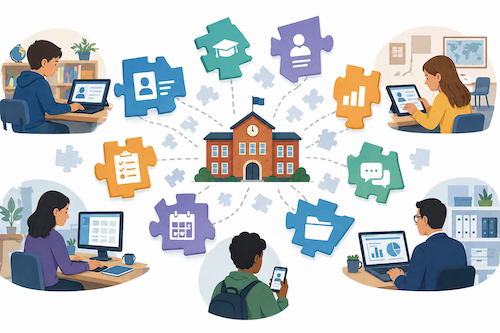
At first glance, having multiple systems in place may seem manageable. Schools often adopt tools incrementally–one for attendance, another for grading, a separate platform for communication, and yet another for reporting. Over time, however, this layered approach leads to fragmented student data, where critical information is scattered across platforms that do not communicate with one another. Many schools are now exploring more unified approaches through modern student information systems that aim to centralize data and reduce duplication.
The operational burden behind data silos
One of the most immediate effects of fragmented data is the operational burden it places on school staff. Administrators and teachers frequently find themselves entering the same information multiple times across different systems. This redundancy is not only time-consuming but also increases the likelihood of errors.
For teachers, the challenge goes beyond data entry. Accessing a complete picture of a student’s performance or history often requires logging into multiple platforms, navigating different interfaces, and piecing together information manually. This process takes valuable time away from instruction and student engagement. As a result, many educators are turning to tools like digital gradebook systems to simplify how performance data is recorded and accessed.
Administrators face a similar challenge when generating reports or making strategic decisions. When data is fragmented, compiling accurate and timely insights becomes a complex task. Decisions that should be data-driven can instead become delayed or based on incomplete information.
The impact on decision-making
Effective decision-making in schools depends on having access to clear, comprehensive, and timely data. When fragmented student data becomes the norm, it disrupts this process.
School leaders may struggle to identify trends in attendance, academic performance, or behavioral patterns because the data needed to analyze these trends is stored in separate systems. Without a unified view, it becomes difficult to answer critical questions such as:
- Which students need additional academic support?
- Are attendance patterns affecting performance outcomes?
- How effective are current intervention strategies?
When these questions cannot be answered efficiently, schools risk missing opportunities to support students at the right time.
Communication gaps with families
Fragmented systems also create challenges in parent and guardian communication. When communication tools are separate from academic and attendance systems, information shared with families can become inconsistent or delayed.
Parents may receive updates from one platform about grades, another about attendance, and yet another about school announcements. This scattered communication experience can lead to confusion and reduce overall engagement.
In contrast, when information flows seamlessly, families are better equipped to stay informed and support their children’s learning. Addressing fragmented student data is therefore not just an operational improvement–it directly impacts the school-home connection. Schools focusing on improving school communication often see stronger engagement when systems are more connected.
Teacher workload and burnout
Teacher workload is a growing concern across K–12 education, and fragmented systems contribute significantly to this challenge. Managing multiple tools, remembering different logins, and navigating inconsistent workflows adds cognitive load to an already demanding role.
Even small inefficiencies such as switching between platforms or duplicating tasks accumulate over time. This added complexity can lead to frustration and reduce the time teachers can dedicate to lesson planning, feedback, and student interaction.
Simplifying how data is accessed and managed can play a meaningful role in reducing this burden. While technology is intended to support educators, fragmented implementation often has the opposite effect.
Why fragmentation persists
Despite these challenges, fragmented student data remains common in many schools. One reason is the way technology adoption typically occurs. Schools often select tools based on immediate needs rather than long-term integration. Budget constraints, limited IT resources, and evolving priorities also influence these decisions.
Additionally, replacing or consolidating systems can feel like a significant undertaking. Concerns about data migration, staff training, and disruption to existing workflows can delay efforts to address fragmentation.
However, as schools continue to rely more heavily on digital systems, the cost of inaction becomes increasingly apparent.
Moving toward more connected systems
Addressing fragmented data does not necessarily require a complete overhaul overnight. Instead, schools can take gradual steps toward more connected and streamlined systems.
A starting point is evaluating existing tools and identifying where duplication or inefficiencies occur. Schools can ask:
- Are multiple systems performing similar functions?
- Where are staff spending the most time on repetitive tasks?
- Which data points are hardest to access or consolidate?
From there, schools can prioritize solutions that improve integration, reduce redundancy, and provide a more unified view of student information.
Professional development and staff input are also critical. Teachers and administrators who use these systems daily can offer valuable insights into what is working–and what is not.
A shift toward simplicity
As the education landscape continues to evolve, there is a growing recognition that more tools do not always lead to better outcomes. In many cases, simplifying systems and reducing fragmentation can have a greater impact than adding new layers of technology.
The conversation is gradually shifting from “What tools do we need?” to “How can our systems work better together?” This shift reflects a broader understanding that efficiency, clarity, and usability are essential for supporting both educators and students.
Conclusion
The hidden cost of fragmented student data extends far beyond administrative inconvenience. It affects decision-making, communication, teacher workload, and ultimately, student success.
By recognizing the impact of data silos and taking steps toward more connected systems, schools can create a more efficient and supportive environment for everyone involved. In a time when data plays a central role in education, ensuring that it is accessible, accurate, and unified is no longer optional–it is essential.
