


Key points:
In mathematics education, we have long relied on a familiar sequence: introduce vocabulary, demonstrate procedures, and assign practice. For some students, this works well enough. But for many students–particularly those in special education, multilingual learners, and those who struggle with language processing–this approach creates barriers before learning even begins.
In my experience as a math teacher, and through ongoing research into how students actually learn, there is a more effective starting point: the way the brain is naturally wired to make sense of the world.
The brain is built for patterns, not procedures
At a fundamental level, the human brain is a spatial-temporal system. It processes patterns over time–detecting structure, predicting outcomes, and adjusting based on feedback. This is not unique to any subset of humans; it is a universal feature of how we think.
When math instruction begins with abstract symbols and language-heavy explanations, it asks students to translate ideas into a form that is not native to this system. For students with language-based learning differences or those still acquiring English, that translation becomes an additional cognitive burden. The result is often frustration, disengagement, and too often the belief that they are “not good at math.”
A visual-first approach, by contrast, aligns directly with the brain’s underlying architecture. When students see, manipulate, and interact with mathematical ideas through patterns, shapes, and movement, they are not translating meaning; they are experiencing it. This allows understanding to develop from the inside out.
Why visual learning expands access
In special education classrooms, one of the most common accommodations in mathematics is the use of manipulatives: physical objects that students can move and organize to represent mathematical relationships. This practice reflects an important truth: When students can interact with math visually and physically, they are more likely to grasp underlying concepts.
However, traditional manipulatives have limitations. They do not inherently provide feedback. A student arranging blocks into an array may not know whether their reasoning is correct without immediate teacher input. In a busy classroom, that feedback is not always available at the precise moment it is needed.
Digital, visual learning environments can extend the power of manipulatives by embedding immediate, meaningful feedback into the experience. When a student attempts a solution, the system responds in real time, and the best systems indicate not just whether an answer is correct, but why. This creates a continuous loop of action, feedback, and adjustment, which is essential for deep learning.
Research consistently shows that this kind of formative feedback–delivered at the moment of thinking–supports stronger conceptual understanding and retention. It also allows students to engage in the good old “productive struggle,” where they refine their thinking through iteration rather than passively receiving answers.
Building understanding before language
One of the most persistent challenges in math education is the overreliance on language as the primary vehicle for learning. While vocabulary and academic discourse are important, they are far more effective when built on a foundation of understanding.
Visual-first instruction flips the sequence entirely. Instead of starting with definitions and procedures, it allows students to construct meaning through interaction and exploration. Only then is language introduced to describe and formalize what they now already understand.
This approach is particularly powerful for multilingual learners and students with language processing differences. By removing language as an initial barrier, it enables them to access complex ideas directly. Over time, this leads to greater confidence not only in problem-solving but also in communicating mathematical thinking.
When students truly understand a concept, they are far more willing and able to talk about it. Language becomes a bridge for sharing ideas and participation, rather than a hurdle to overcome.
Connections to music and creative thinking
This same need for pattern recognition shows up across domains. Music, like mathematics, is built on patterns over time; we anticipate structure, notice variation, and respond to shifts in rhythm and harmony.
As a musician, I don’t learn or write by starting with explanations. It happens through listening, playing, experimenting, and adjusting in real time, the same way students internalize math when they engage with patterns visually and dynamically.
Research on early brain development shows that experiences like music strengthen spatial-temporal reasoning, which supports mathematical thinking. Together, these connections point to the value of approaches that engage the brain holistically, rather than isolating skills into language-bound tasks.
What district leaders should look for
If we’re serious about improving math outcomes, we have to ask a different set of questions than we’ve been asking. Not just about what is being taught, but how students are experiencing it. For district leaders seeking to improve math outcomes for diverse learners, the key question is whether the learning experience aligns with how the brain works.
- Do students have a way into math before language becomes a barrier?
- Are they actively making sense of ideas, or passively receiving procedures?
- Do they get feedback in the moment of thinking while their reasoning is still forming?
- Does this experience build intuition first, so that language and symbols have something to attach to?
When these answers are “yes,” the impact can be profound.
A more inclusive vision for math learning
Mathematics is often perceived as a gatekeeper subject–one that separates those who “get it” from those who do not. But this perception is largely a product of how we teach it.
When we change the way math is experienced, we don’t just improve outcomes. We change who gets to see themselves as capable.
Notice that by starting with ostriches and dogs displayed visually, students can determine the number of legs on the animals purely by counting the visuals. But as more symbols are introduced, the same idea is approached through mathematical operations. The spatial underpinning of the operation is developed first, and the symbols are introduced once the student understands what the symbols mean in context.
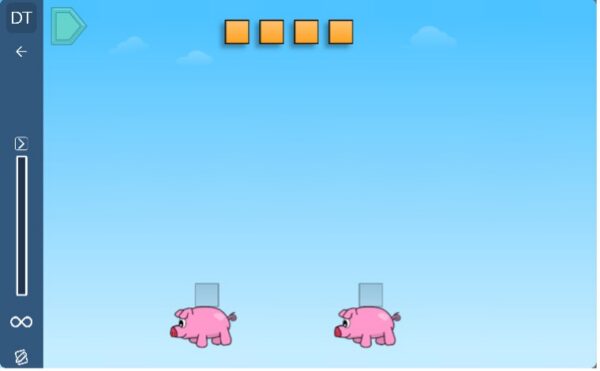
In this game, Fair Sharing, which you can play here, students drag the blocks onto the two frogs. If they place two blocks on each from then the animated feedback shows the penguin is able to cross the bridge. However, if they place the blocks in any other way, the bridge breaks and the penguin (JiJi) is unable to cross. The fundamental concept of division is developed through a visual interactive experience long before the student needs any definitions or verbal instruction about what division means.
